Custom Wood Floor Vents: Complete Guide for GTA Homes
Standard stamped-metal floor registers stand out against hardwood like a mismatched patch. Here is how custom wood floor vents are made, matched, and installed.
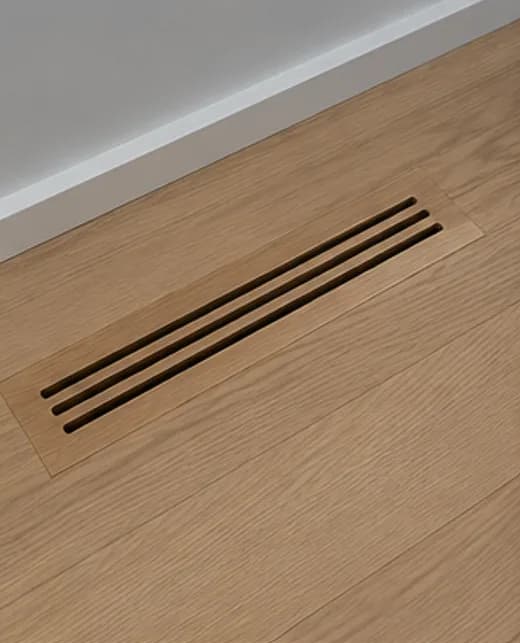
A new hardwood floor makes an old problem obvious: the stamped-metal floor register that came with the house. Once the flooring around it is new and properly finished, that mismatched metal grille reads as an afterthought — and it is one of the most overlooked details in an otherwise complete renovation.
Why Standard Registers Look Wrong on a New Floor
Off-the-shelf floor registers are made in a handful of stock finishes — brushed nickel, oil-rubbed bronze, plain aluminum — none of which are designed to match a specific hardwood species or stain. Against a freshly finished floor, the mismatch is immediate: different material, different sheen, often a visibly different size than the opening it's covering. A custom wood vent solves this by being machined from the same species and finished with the same stain and topcoat as the surrounding floor, so the vent disappears into the field rather than interrupting it.
How Custom Wood Vents Are Made
Each vent starts as a solid or engineered wood blank matched to your flooring species — Oak, Maple, Walnut, Hickory or whatever species is already on your floor. The face is precision-milled with parallel slots sized for adequate airflow, then sanded and finished with the same stain formula and topcoat sheen as the floor itself, so the grain and colour carry through continuously. The housing is built to fit your existing duct opening, with a damper mechanism installed to control airflow exactly as a standard register would.
Vent Styles We Build
- Linear Slot Vent — our most requested style: rows of precisely milled parallel slots in standard or custom widths from 75mm to 900mm, available flush-fit or surface-mount in any hardwood species.
- Wide Plank Register — machined from a single wide board with an end-to-end slot pattern, built specifically to blend into wide-plank flooring installations without breaking the visual continuity of the boards.
- Tall Narrow Register — a portrait-format vent for baseboard or low-wall installations, useful beside kitchen islands, under counters, or anywhere a compact horizontal footprint is needed.
- Round Face Register — a square housing with a circular slotted face, finished in ebonised oak or smoked wood for a stronger geometric statement than a standard linear vent.
See the full custom vents range for photos of each style, including our magnetic damper option for a cleaner, hardware-free face.
Floor Vents vs. Baseboard Vents
Most custom wood vents replace an existing floor register in place, matched to the same opening size and duct location. Where a floor location isn't practical — beside a kitchen island, under a run of cabinetry, or in a room being reconfigured — a tall narrow register can be built into the baseboard or a low wall instead, redirecting the same duct run to a wall-height opening. This is a design decision best made during your flooring consultation, since it can affect duct routing.
Matching an Existing Floor vs. a New Installation
If you're installing new flooring, matching the vent is straightforward — we finish it alongside the floor from the same material and stain batch, guaranteeing an exact match. If you're adding custom vents to an existing floor, we bring finished samples to match against your floor in person, since stain colour and sheen can shift slightly over the years from sun exposure and foot traffic — a vent finished from a fresh stain can sometimes read slightly different from a floor that's aged a few years, and we account for that during the match rather than assuming a straight formula match will look right.
What Affects Cost
Pricing depends on vent size, wood species, finish complexity (a simple linear slot in a common species costs less than a round-face vent in ebonised exotic hardwood), and whether it's a straightforward floor-register replacement or a more involved baseboard installation requiring duct rerouting. Because every vent is a custom fabrication rather than a stock item, we quote each one individually after seeing the space and the floor it needs to match — there isn't a meaningful "typical" price without knowing those specifics.
Maintenance
A wood floor vent is finished with the same topcoat as your floor, so it's cared for the same way — regular sweeping or vacuuming to clear dust from the slots, and avoiding standing water directly on the vent face. The damper mechanism itself is a simple, low-maintenance component that rarely needs attention beyond occasional cleaning.
Frequently Asked Questions
Can a custom wood vent be installed without replacing my flooring? Yes — if you're happy with your existing floor and only want the registers replaced, we can match a vent to it directly, no flooring work required.
Do wood vents affect airflow compared to metal registers? No — the slot pattern is engineered for equivalent open area to a standard register, and the damper mechanism works the same way.
Can you match a floor that isn't one we originally installed? Yes, we regularly match vents to existing floors installed by other contractors — we bring finished samples to your home to confirm the match before fabrication.
See our flooring services for the full range of species and finishes we work with, or visit the custom vents page to see every style in detail. Contact RiseOnStairs for a free consultation — bring us a photo of your floor or vent opening and we'll walk you through what's possible.
Ready to begin?
Let's bring your vision to life
Our team of master craftsmen is ready to help you design the perfect staircase or flooring for your home.